
Powered By



 Continue with Facebook
Continue with Email
Continue with Facebook
Continue with Email
Have you ever wondered why certain health conditions seem to occur together? For example, researchers have found connections between chronic hives and autoimmune diseases like lupus, with studies showing that people with chronic hives are more likely to also have lupus.
But how are chronic hives and lupus connected, and what would cause you to have both conditions? In this article, we’ll explain what chronic hives and lupus are, how they’re connected, and what you need to know to manage both conditions.
Because both chronic hives and lupus affect the immune system, researchers think these conditions might be linked by the way the immune system works. Chronic hives are a skin reaction, whereas lupus is an autoimmune disease.
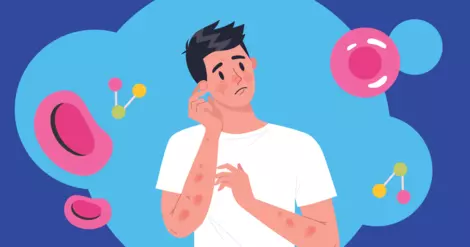
Hives, or urticaria, are raised, itchy patches or welts that can appear anywhere on the body. These patches may look lighter or darker than your usual skin color, depending on your skin tone. They may come and go, lasting for a few hours before fading, only to show up somewhere else later.
When hives last for six weeks or longer, doctors call it chronic urticaria (CU). There are two main types:
Also known as chronic idiopathic urticaria (CIU), chronic spontaneous urticaria (CSU) has no clear cause. The immune system mistakenly releases histamine and other chemicals, causing itching and swelling. Triggers aren’t always known, though stress, infections, or autoimmune activity can sometimes play a role.
Chronic inducible urticaria (CIndU) occurs when hives are caused by a specific trigger, such as heat, cold, pressure, sunlight, or exercise. When you remove or avoid triggers, symptoms usually improve, but sometimes they persist.
Researchers believe that autoinflammation may play a role in chronic hives. Autoinflammation happens when your body’s immune system releases too many inflammation-causing chemicals. Your immune system is designed to protect your body from harm. When you have an autoimmune disease or reaction, autoantibodies mistakenly cause inflammation throughout your body. People with chronic hives are at an increased risk of developing autoimmune diseases like rheumatoid arthritis.
Systemic lupus erythematosus (SLE or lupus) is an autoimmune disease that causes the body to attack its own tissues and organs. It causes inflammation and damage to different parts of your body, like your skin, kidneys, brain, and heart.
Some SLE symptoms include:
Lupus symptoms can come and go. When they’re present, it’s called a flare-up. Everyone shows different lupus symptoms, depending on which tissues and organs are affected.
The exact cause of lupus is not clear. Different factors may contribute to the development of lupus, like genetics, hormones, environmental factors, and habits like smoking.
One systematic review found that people with CSU are about five times more likely to have SLE than people without chronic hives. This finding raises the question of whether there’s a relationship between the two conditions.
There’s no evidence to suggest that CSU directly causes lupus. Only 10 percent of people with SLE will experience some kind of hives. Additionally, about 1 in 5 people with CSU also have an autoimmune disorder, such as lupus.
Connections between lupus and chronic hives lie in shared immune pathways, genetic factors, and infections.
Sometimes, the immune system will make antibodies that mistakenly harm your own body’s tissues and organs instead of protecting them. These harmful antibodies are called autoantibodies. Several specific autoantibodies play a role in both CSU and SLE.
Some people may have certain genes that make them slightly more likely to develop both CSU and SLE. For example, some researchers have found that changes to the gene HLA-DRB1*04 are a risk factor for both CSU and SLE. Other allergic conditions like asthma and allergic rhinitis also seem to share genes with SLE.
The HLA-DRB1 gene is part of a group of genes called the human leukocyte antigen (HLA) complex. This gene contains the instructions that help the immune system tell substances like bacteria and viruses apart from the body’s own proteins.
Studies have found that infection with Helicobacter pylori (H. pylori, a type of bacteria that can affect the stomach) may be a risk factor for both CSU and SLE. That means that people who had a Helicobacter pylori infection were more likely to have CSU or SLE. Researchers believe this link is because H. pylori can alter the balance of good bacteria in the gut.
Lupus can cause a variety of skin symptoms that have nothing to do with hives. Some of these skin conditions may look like hives and may also be itchy. Here are some of the common lupus skin problems and how they differ from chronic hives.
One type of lupus-related skin condition that can look like hives is called cutaneous vasculitis. Cutaneous vasculitis causes inflammation in the blood vessels in the skin, which leads to lesions on the skin that may look like hives and be itchy.
There are several key differences between cutaneous vasculitis and chronic hives:
To find out if a skin rash is chronic hives or cutaneous vasculitis, healthcare providers might perform a skin biopsy. This means they take a small piece of skin to look at under a microscope. Your healthcare provider will also check for specific symptoms distinct to each condition.
A malar rash is common in people with lupus — about 50 percent of people with lupus develop this rash at some point. The rash resembles a butterfly across the face. It’s a raised, reddish or skin-colored rash that spans over the nose and across the cheeks.
A malar rash is different from chronic hives in that it’s not usually itchy, and while it can come and go, it always occurs on the same spot on the face. Chronic hives may appear and then fade over time, but they occur on different parts of the body, and they are usually itchy. One similarity is that both a malar rash and chronic hives may be triggered by sunlight.
Photosensitivity occurs when someone is extremely sensitive to sunlight and ultraviolet (UV) radiation. About half of people with lupus have photosensitivity. In people with photosensitivity, sunlight can cause skin rashes and a more severe sunburn-like reaction, resulting in a severe burning sensation and pain.
Chronic hives are different from photosensitivity and photosensitivity-related skin reactions in that they can have other causes and triggers. While sunlight can trigger chronic hives, other factors like exposure to heat or cold, skin pressure, other medical conditions, and vibrations can also cause hives.
Livedo reticularis is a lacy, netlike pattern on the skin that people with lupus may experience. On some people, this rash can be a violet or reddish color and occurs underneath the skin’s surface. It’s more common during cold weather and in women and infants, according to Johns Hopkins Lupus Center.
Livedo reticularis is different from chronic hives because it’s a rash underneath the skin’s surface, and it doesn’t cause swelling or raised, itchy patches of skin.
Approximately 1 in 4 individuals with lupus develop sores or ulcers inside their mouth or nose. These sores can look like canker sores. Chronic hives, on the other hand, do not occur inside the mouth or nose.
Learning about how hives and lupus are connected, and how their skin symptoms are different, can help you feel more informed when talking to your healthcare provider.
Keeping a detailed log of your skin symptoms, including details about what they look and feel like, when they occur, and what you’re doing when they occur, can help your doctor diagnose your skin condition.
Some questions to consider when speaking with your healthcare provider include:
Make sure you discuss your medical history and any medications you are taking with your doctor. They may refer you to a dermatologist (a skin specialist) for further testing and evaluation.
Having chronic hives does not mean you will develop lupus. However, if you do have chronic hives and other symptoms, your healthcare provider may order lab tests to rule out autoimmune conditions like lupus or thyroid disease. To look for conditions that may occur with chronic hives or cause them, doctors suggest doing some basic tests to screen for other health problems.
Diagnostic tests for lupus and other autoimmune conditions may include:
While having chronic hives doesn’t mean you have lupus, testing for autoimmune conditions can help your care team better understand your condition and make the best decisions for your overall health.
On MyChronicHivesTeam, people share their experiences with chronic hives, get advice, and find support from others who understand.
Do you have chronic hives, and have you been diagnosed with lupus or another autoimmune condition? Let others know in the comments below.
Get updates directly to your inbox.




 Continue with Facebook
Continue with Email
Continue with Facebook
Continue with Email
Continue with Facebook
Continue with Email
Continue with Facebook
Continue with Email
Become a member to get even more





 Join
Join


 Your Privacy Choices

This is a member-feature!
Sign up for free to view article comments.
This was an interesting article for me because, although I don't have chronic hives, I have had a few bouts with them, and I have lupus. But the most interesting thing for me is that when my oldest… read more
We'd love to hear from you! Please share your name and email to post and read comments.
You'll also get the latest articles directly to your inbox.