
Powered By



 Continue with Facebook
Continue with Email
Continue with Facebook
Continue with Email
If you’ve ever had an itchy outbreak on your skin, you know how confusing it can be to figure out what’s happening. Is it an allergic reaction? A rash? Hives? These terms are often used interchangeably, but they don’t all mean the same thing.
“Skin rash” is a general term for any visible change or irritation on the skin, while chronic hives (also called chronic urticaria) are a specific condition that lasts for six weeks or longer. Chronic hives can linger for months or even years. Knowing the difference between these conditions and understanding your symptoms can help you and your doctor find the best treatment.
Here’s what makes chronic hives unique, how they differ from other types of skin rashes, and steps you can take to find relief.
Hives, known medically as urticaria, are raised, itchy welts that can appear suddenly anywhere on the body. They’re usually discolored and can vary in size from small dots to large patches. In most cases, hives resolve within a few hours or days. They are often caused by a clear trigger, such as an infection, certain foods, medications, insect bites, or stress.
However, when hives last longer than six weeks, they’re considered chronic hives. Unlike acute (short-term) hives, chronic hives can come and go unpredictably over weeks, months, or even years. These episodes often happen without warning, making them frustrating and sometimes difficult to manage.
Chronic hives affect about 5 percent of people. They’re most common in women who are 30 to 50 years old, according to Cleveland Clinic.
Chronic hives fall into two main categories. The first is chronic spontaneous urticaria (CSU), also called chronic idiopathic urticaria (CIU). In this form, hives appear “spontaneously,” meaning there’s no obvious trigger. The immune system may become overactive, causing the release of histamine and other chemicals that lead to swelling, changes in skin color, and itching. CSU is the most common type of chronic hives.

Chronic inducible urticaria (CIndU) is another type that’s triggered by specific physical or environmental factors. Triggers can include:
Hives from CIndU usually appear soon after exposure to a trigger and fade once the trigger is removed.
Regardless of the type, chronic hives tend to move around the body. A patch might appear on your arm one day, then vanish and show up on your leg the next. This shifting nature, along with intense itching, can be a key feature separating hives from many other skin conditions.
“Skin rash” is a broad, umbrella term. It describes any visible change in the skin’s appearance or texture. Unlike hives, which are characterized by raised, puffy welts, rashes can take many forms. They may be scaly, crusty, blistered, or flat.
Skin rashes are very common. Almost everyone experiences one at some point, and they can affect people of any age or skin tone.
Some common types of skin rashes include:

Because “skin rash” can mean many different conditions, it’s important to pay attention to the specific appearance and texture. Try to notice if anything might be triggering your rash, and track any other symptoms you have.
Technically, chronic hives are a type of rash. But not all rashes are chronic hives. Think of “rash” as the broad category and “chronic hives” as one specific kind within that category.
The distinction matters because chronic hives behave differently from other rashes. They are usually raised and pale or discolored, and they often appear suddenly. Hives tend to move around the body, sometimes disappearing within hours and then showing up in a different spot.
In contrast, most rashes — like those from psoriasis or eczema — stay in the same area and often have a rough, scaly, or thickened texture.
While both conditions cause visible skin irritation, chronic hives are a diagnosis, not just a symptom. Doctors recognize chronic urticaria as a medical condition, and it often involves the immune system.
Rashes, on the other hand, are usually a symptom that can have many different causes, such as a reaction to something external or an underlying health issue.
Chronic hives are often immune-related or idiopathic (meaning there is no known cause). Triggers like stress, infections, or autoantibodies (proteins that mistakenly target your own body) may play a role.
Skin rashes, depending on their underlying diagnosis, usually have a clear cause. Allergies, infections, or autoimmune skin diseases (such as psoriasis or eczema) may be responsible for skin rashes.
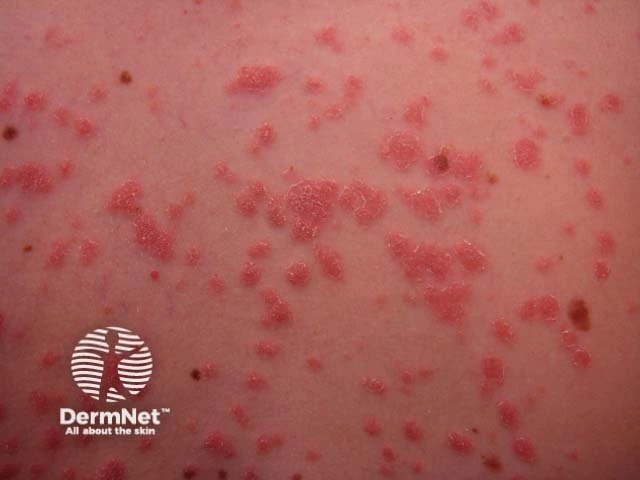
Chronic hives are usually raised, soft welts that are often pale or lighter in the center, with a discolored or darker-hued border. The welts tend to move around the body and usually disappear within 24 hours, only to appear somewhere else.

Skin rashes may look scaly, crusty, blistered, or thickened. The appearance can vary widely depending on the type of rash. Most rashes stay in the same area for days or weeks, gradually fading as they heal.
Chronic hives last for six weeks or more, and flare-ups can come and go without warning. Some people may experience symptoms for months or even years, with periods of improvement in between.
Skin rashes usually fade with treatment or after the trigger is removed. Most rashes stay in one place until they heal and are less likely to come and go in different areas like hives do.
Chronic hives usually cause intense itching. Sometimes, they’re accompanied by deeper swelling called angioedema, which often affects the lips, eyelids, or hands.
With other skin rashes, the amount of itching can vary depending on the cause. Swelling is less common with most rashes, unless the rash is part of a severe allergic reaction.
If you notice itchy welts showing up every day or several times a week for more than six weeks, it’s important to talk to a healthcare provider about the possibility of chronic hives. You might also suspect hives if:
On the other hand, it’s more likely you have a different type of rash if:
A dermatologist can make the final diagnosis by carefully examining your skin.
Because chronic hives and rashes have different underlying causes, they may need different treatment.
For chronic hives, treatment can include:
Other treatments for chronic hives include:
For other skin rashes, treatment depends on the root cause:
If your hives or rash are persistent, are painful, or come with swelling around the face or difficulty breathing, seek medical attention immediately. These could be signs of anaphylaxis, a life-threatening allergic reaction, or other serious conditions.
For chronic or recurring symptoms, consider asking your healthcare provider about getting an allergy test or being screened for an autoimmune disease. Many cases of chronic hives are linked to the immune system, so finding the underlying trigger can be key to long-term relief.
If your skin irritation keeps returning or doesn’t respond to typical treatments, it’s worth taking a closer look. With the right diagnosis and care plan, you can calm the itch, heal your skin, and feel comfortable again.
On MyChronicHivesTeam, people share their experiences with chronic hives, get advice, and find support from others who understand.
Have you experienced rashes or chronic hives? Let others know in the comments below.
Get updates directly to your inbox.


How does it look


 Continue with Facebook
Continue with Email
Continue with Facebook
Continue with Email
Continue with Facebook
Continue with Email
Continue with Facebook
Continue with Email
Become a member to get even more





 Join
Join

 Your Privacy Choices

This is a member-feature!
Sign up for free to view article comments.
How long is this treatment? My son is suffering and i want to help him.
We'd love to hear from you! Please share your name and email to post and read comments.
You'll also get the latest articles directly to your inbox.